

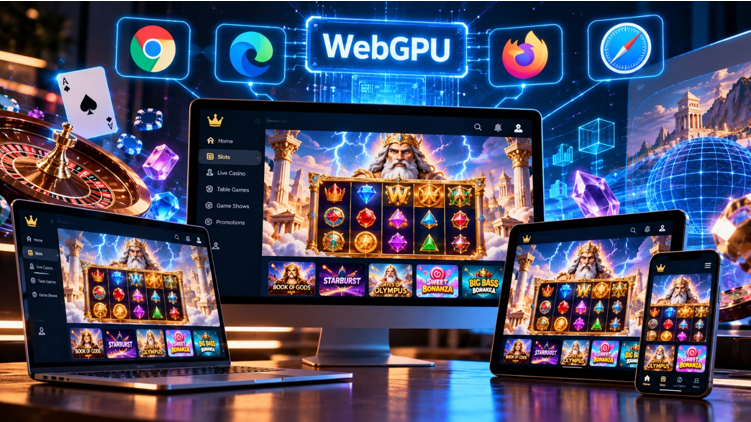
For years, playing directly in a browser meant accepting certain limitations compared to an installed application. WebGL allowed slots, table games, and 3D experiences to improve enormously across any online casino platform, although it was built on graphics technology designed long before today’s GPUs. WebGPU changes that foundation by allowing websites to use modern graphics hardware much more efficiently, bringing browser capabilities closer to technologies such as Metal, Vulkan, and Direct3D 12. What matters now is that this possibility is no longer limited to a single browser and is becoming available across Chrome, Edge, Firefox, and Safari.
Safari Was the Last Major Obstacle
Chrome led the way when it enabled WebGPU by default in 2023, while Edge inherited the same capability through Chromium. Firefox followed with its rollout starting in version 141 on Windows and has gradually expanded compatibility to other operating systems. The missing piece was Safari, particularly important because of the significant share of mobile traffic generated by iPhones and iPads. Apple eventually introduced WebGPU in Safari 26 for macOS, iOS, iPadOS, and visionOS.
However, an important distinction needs to be made. Support across the four major browsers does not mean that every older device can run the same features. Compatibility still depends on the operating system, GPU, and browser version. PlayCanvas, for example, lists support for Chrome and Edge starting from version 113 on certain platforms, Safari from version 26, and Firefox from version 141 on Windows, with gradual expansion to macOS. The main difference compared to a few years ago is that developing for WebGPU no longer means investing in a technology restricted to a single ecosystem.
WebGPU Does Something WebGL Could Not Do in the Same Way
The technical shift matters because WebGPU was designed from the outset around the architecture of modern GPUs. It can reduce some of the workload handled by JavaScript, manage complex graphics commands more efficiently, and use compute shaders, which allow calculations to be sent to the GPU without necessarily being related to rendering pixels. WebGL played a crucial role in bringing advanced graphics to the web, but WebGPU provides more direct and flexible access to a device’s parallel processing capabilities.
In an online casino, these improvements can translate into highly visible changes. A slot game can handle more particles, dynamic lighting, 3D objects, and transitions without placing as much strain on the main processor. A digital roulette game can incorporate more sophisticated physics and materials, while a casino lobby can become a navigable three-dimensional environment without requiring users to install a separate application.
The improvement does not necessarily have to mean making games more visually spectacular. Better GPU utilization also makes it possible to distribute certain workloads more efficiently and keep complex interfaces running more smoothly. This is particularly relevant when the same platform needs to operate across devices with very different hardware capabilities.
The Browser Is Starting to Resemble a Gaming Platform
This evolution is also supported by tools that significantly lower the barriers for development studios. PlayCanvas already offers an engine capable of using WebGPU and automatically falling back to WebGL 2 when a device is incompatible. Meanwhile, Unity allows developers to set WebGPU as the preferred graphics option while keeping WebGL as a fallback. This means providers can begin exploring the new capabilities without immediately abandoning users with older hardware. Similar transitions are common in software, where new capabilities are increasingly added to existing products instead of requiring an entirely new technological environment.
Unity’s progress is particularly significant because, in 2026, WebGPU moved beyond its experimental stage within the engine and became a supported technology for web projects. At the same time, Babylon is developing Babylon Lite directly on WebGPU and claims to have achieved substantial improvements in CPU time and engine size compared to its traditional architecture in certain test scenes.
For the iGaming industry, this could accelerate a trend that has been developing for years. As browsers gain increasingly advanced graphics and computing capabilities, the need to maintain a web experience that is clearly inferior to a native application begins to diminish. Users can follow a link and access a game immediately, while providers maintain a single technological foundation capable of running across different operating systems.
Slots Could Be Just the Beginning
Slots often come to mind first because they are among the gaming formats where animations, visual effects, and 3D environments are most noticeable. However, WebGPU opens up much broader possibilities. Games featuring digital dealers, game show experiences, three-dimensional tables, and even interactive casino lobbies can benefit from technology capable of handling more complex scenes directly in the browser.
What happens behind the graphics is equally interesting. Compute shaders allow GPUs to perform parallel calculations, meaning they can be used for simulations, image processing, particle effects, and certain artificial intelligence functions running locally. This does not mean every casino will immediately introduce browser-based AI, but it considerably expands what providers can develop without always relying on a remote server.
Nevertheless, WebGPU will not transform the appearance of every game overnight. Studios will have to decide which experiences justify rebuilding engines, shaders, and rendering pipelines, while WebGL will continue to serve as a fallback for quite some time. That is precisely what makes the current moment so interesting. The question is no longer whether a browser can run advanced graphics, but how far developers should take those capabilities.
For online casinos, this evolution could ultimately prove significant because it preserves one of the web’s greatest advantages, the ability to access and play games without installing anything, while gradually narrowing the technical gap that has separated browsers from native applications for years. WebGPU cannot replace good design, engaging content, or well-developed game mechanics on its own, but it provides a much more ambitious foundation on which to build them.