

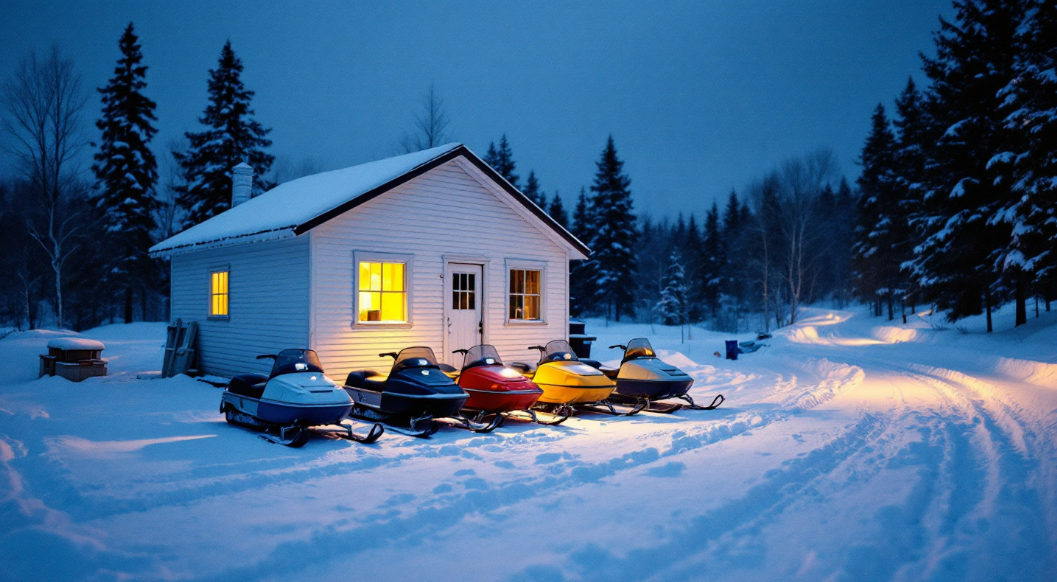
Muskoka already plays more poker than it lets on. It just tends to do it outdoors, at speed, with a helmet on.
Every winter, sledders up here pay an entry fee, ride a loop of groomed trail and check in at a handful of stops along the way. At the end they hold five playing cards, and the best hand takes a prize.
It’s called a poker run, and it has been on the cottage country calendar for years.
Nobody bluffs on a poker run. Nobody folds, either. The cards land how they land, and the real draw is the ride, the supper and the cause.
The other kind of poker, the kind with decisions in it, is an indoor game. It suits the stretch between the last boat coming out of the water and the first trails opening.
It’s also easier to pick up than it used to be. The rules, the hand rankings and the odds are laid out free in the beginner sections that online poker sites now publish, and an evening with them covers what most kitchen tables teach by trial and error.
The Poker Run Is A Local Tradition Hiding In Plain Sight
The format is simple. Participants visit a set of checkpoints, usually five to seven, and end up with one playing card for each. Some runs hand out a card at every stop, and others deal the whole hand back at the hall.
Two of the winter runs are close to home. In Gravenhurst, the local snowmobile club’s annual poker run was listed last season with three planned loops or a build-your-own route of five stops.
In Dorset, on the boundary between Muskoka and Haliburton, the Dorset Poker Run goes out of Lions Camp Dorset. The 2026 edition was planned for 250 riders and five checkpoints.
There’s no shortage of trail to hold them on. The clubs of OFSC District 7, which takes in Muskoka and North Simcoe, look after roughly 1,800 kilometres of it between Georgian Bay and the edge of Algonquin Park.
What A Poker Run Hand Is Really Worth
Because nobody chooses their cards, a poker run is pure chance. That makes it a tidy lesson in how rare the good hands are.
Deal five cards from one shuffled deck and the numbers look like this:
- No pair at all: about 50 per cent of the time
- One pair: about 42 per cent
- Two pair: roughly 1 hand in 21
- Three of a kind: roughly 1 in 47
- A straight: roughly 1 in 255
- A flush: roughly 1 in 509
- A full house: roughly 1 in 694
Put another way, more than nine hands in ten are a single pair or worse. The rider who turns over three of a kind at the hall has every right to be loud about it.
Why The Card Table Suits The Muskoka Off-Season
The numbers explain the quiet. The District of Muskoka counts 66,674 year-round residents and a seasonal population of 84,400, spread over a region with more than 640 lakes.
When the seasonal crowd goes home, more than half of that combined population goes with it.
Then the light goes. At the winter solstice, Bracebridge gets less than nine hours of daylight, and the sun is down by about 4:40 in the afternoon.
That leaves a long evening to fill, and the plans that survive are the ones that don’t lean on the roads.
A card game asks for a table, a deck and somewhere between four and eight people who live a short drive apart. It also forgives a late cancellation, because a game planned for seven runs perfectly well with five.
On a doubtful night, a look at Muskoka411’s weather cam before anyone backs out of the driveway takes about ten seconds.
Hold’em Asks Different Questions Than A Poker Run
Texas hold’em is what most people mean now when they say poker. Each player gets two private cards, five shared cards arrive in the middle of the table in stages, and there’s a round of betting at every stage.
The hand rankings are the same ones a poker run uses. A flush still beats a straight, and a full house still beats both.
What changes is that you can fold.
That single option turns a draw into a game. You see two cards, decide whether they’re worth money, and get three more chances to change your mind as the board fills in. Most of the skill is knowing when to let go.
The One Sum Worth Learning
Poker arithmetic has a reputation it doesn’t deserve. One calculation, called pot odds, does most of the work, and it’s no harder than splitting a dinner bill.
Say you hold two hearts, and two more hearts are among the four cards showing on the table. One card is still to come. Nine hearts are left among the 46 cards you can’t see, so you’ll complete the flush a little under one time in five.
Now look at the price. There’s $8 in the pot and your opponent bets $2, so you’re being asked to put in $2 to win $10. That call only has to work more than one time in six to pay for itself.
One in five beats one in six. Call.
Change the bet to $8 and the answer flips. Now you’re paying $8 to win $16, and that needs to come in better than one time in three. It won’t, so the right play is to fold and feel fine about it.
The Habits That Cost Beginners Most
GGPoker, whose Ontario site is regulated by the Alcohol and Gaming Commission of Ontario, publishes a short list of poker strategy tips for new players.
The first habit is patience. The rule of thumb on that page is that anyone getting involved in more than half the hands they’re dealt is probably playing too many.
The second is letting go. Its example is an ace and a king, a strong start, on a board of four, six, six with an opponent betting big. Having raised earlier is no reason to stay in.
The rest is about the player. Watch the others at the table when you’re not in the hand, don’t bluff until you know when a bluff works, and don’t sit down in a bad mood.
Setting Up A Winter Game That Lasts
The home games that run for years tend to look dull on paper. The stakes are small, the rules are written down and the night ends when it’s supposed to.
A workable set of house rules fits on the back of a score pad:
- Adults only at the table. In Ontario that means 19 and over.
- Agree on a buy-in everyone can lose without thinking about it, and cap the rebuys.
- Set the finish time before the first deal and hold to it, whoever’s ahead.
- Nobody takes a cut. Every dollar on the table goes back to the players.
- Rotate the host, so the driving and the snacks get shared out over the winter.
- Anyone who wants to sit out a hand, or the whole night, does it without comment.
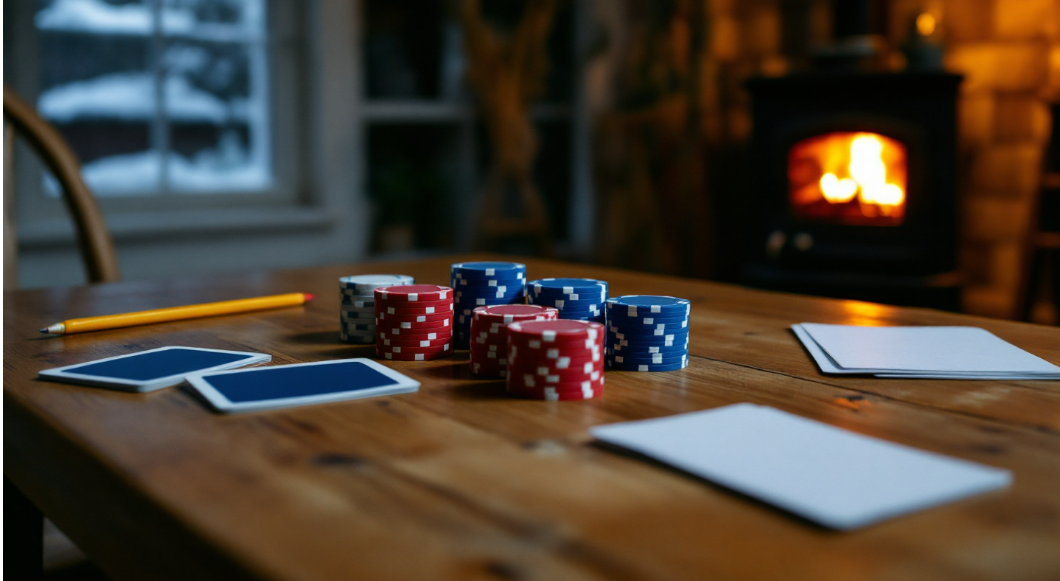
The equipment list is short: a chip set and two decks of cards. With two decks, one gets shuffled while the other is being dealt, and a slow table speeds up noticeably.
When Half The Table Has Gone Back To The City
The hard part of a winter game in cottage country is the roster. The neighbour who never missed a Friday in August is a long drive south until the long weekend in May.
The online version covers some of that gap. For people who’d rather play poker with friends than sit in silence, GGPoker’s tables carry a fair amount of the table talk.
Players can send emoji during a hand, record voice messages of up to 120 seconds and share camera clips of up to 15 seconds. Anyone who’d rather have quiet can block the clips from their profile.
The advice about stakes carries over. The site’s beginner tips suggest starting at the smallest games, five and ten cents.
A feature called PokerCraft shows a player’s history, including results with particular starting cards and from different seats.
Keep It A Game
A poker run works because the stake is an entry fee and the point is the day out. The kitchen table and the app deserve the same standard.
Decide what the evening is worth before it starts, the way you’d budget for dinner in town, and stop when that’s spent. Don’t chase a loss. Don’t play tired, angry or because there’s nothing else on.
The off-season is long enough to learn hold’em properly and short enough that the trails will be open before anyone has it figured out.
By February the sleds will be lined up outside a hall somewhere, and five cards will be waiting at the end of the loop. At least you’ll know what they’re worth.
Poker is for adults 19 and over in Ontario. Please play responsibly. ConnexOntario offers free, confidential support at 1-866-531-2600.