

The District Municipality of Muskoka, ON has received national recognition from the Canadian Association of Municipal Administrators (CAMA) for its Bin Site Transition Project. The municipality was presented with the 2026 CAMA Environmental Leadership & Sustainability Award, in the 20,001 to 100,000-Population Category, during an awards ceremony held at CAMA’s national conference in Whistler, BC.
“CAMA is pleased to recognize the District Municipality of Muskoka for the municipal excellence demonstrated by its Bin Site Transition Project,” said Brenda Orchard, CAMA President, CAMA Representative for Ontario, and Chief Administrative Officer for Lennox and Addington County, ON. “The project delivered significant and lasting benefits by addressing long standing environmental risks and modernizing a system that no longer met community needs or provincial expectations.”
“The Bin Site Transition Project offers practical lessons for municipalities navigating change. It highlights how municipalities can responsibly modernize long‑standing services, despite incomplete data, while advancing environmental protection and maintaining essential access for residents, said Renee Recoskie, Director, Waste Management and Environmental Services with the District Municipality of Muskoka, ON. “Above all, it shows that thoughtful, respectful community engagement can support positive outcomes, even within the complexities of rural and waterfront communities.”
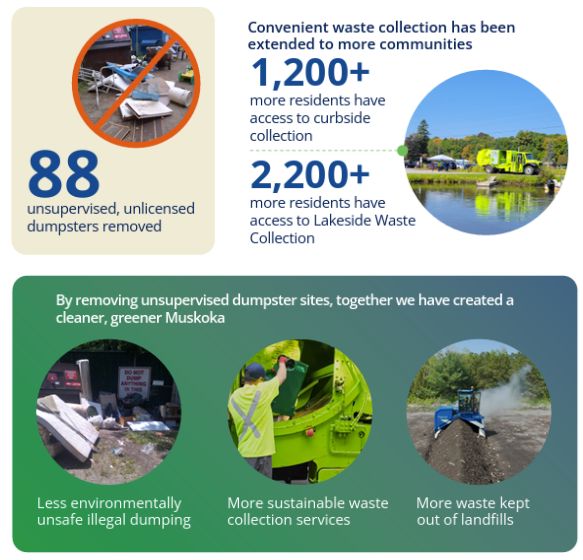
The District successfully transitioned almost ninety historic unsupervised bin sites to a modern compliant waste service system through a multi-year initiative that placed community engagement, environmental stewardship and operational excellence at the forefront. The work began in 2019 and reached substantial completion in 2025.
The project replaced unsupervised dumpsters with curbside collection on public and private roads, Lakeside Waste Collection for water access communities, and new or improved waste drop off depots. These updated services addressed long-standing environmental risks and created a strong foundation for improved diversion and climate benefits.
The transition affected approximately six thousand properties. By project completion, more than 1,200 units had been moved to curbside collection, 2,250 units had transitioned to Lakeside Waste Collection and the remaining units were served through supervised waste drop-off facilities.
These alternatives deliver significantly higher diversion performance than the former sites and are projected to prevent more than 40,000 bags of divertible garbage from reaching the landfill each year. The work aligned with District strategic objectives to protect the natural environment, modernize services and plan for the future. A formal climate lens confirmed additional benefits when compared with the legacy system.
The project strengthened the organization itself, resulting in new tools for such as private road inspections, refined communications practices, and enhanced use of digital platforms, as well as strengthened community relationships.
“The Awards committee was amazed by the ingenuity being demonstrated by communities from across the country when it comes to programs, projects and services being offered at the local level,” said Tracy Thomas, Awards Chair and CAMA Board Representative for NWT, YT and Nunavut. “Congratulations to the winners and all those who took the time to enter a submission.”
A total of 41 submissions were received for this year’s awards program. To find out more about each award, and to see a video outlining each project, visit www.camacam.ca/awards and look for the award recipients’ link.