

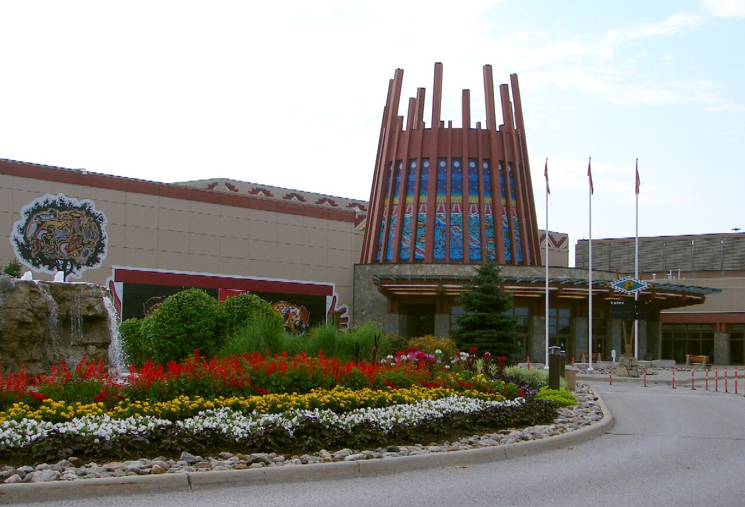
Casino Rama Resort marked its 30th anniversary this July. In a region where year-round full-time work outside tourism and construction is thin on the ground, the number worth noting is not the size of the gaming floor. It is 1,100, the property’s current headcount, and 146, the number of those employees who have been there since the doors opened in 1996.
The anniversary lands in the middle of a refurbishment. Gateway Casinos, which operates the property under contract, announced the project in partnership with the Ontario Lottery and Gaming Corporation and Rama First Nation, covering hotel rooms, an expanded spa and fitness centre, the gaming floor and the common areas. The work comes with additional hiring.
Ontario’s Only First Nations Commercial Casino
Casino Rama is jointly owned by the Chippewas of Rama First Nation and OLG, and it remains the only First Nations commercial casino in Ontario and the largest in Canada. It sits in Simcoe County about 30 minutes north of Barrie, which puts it inside a realistic commute for households across southern Muskoka and the Severn corridor.
The property also runs a 5,000-seat Entertainment Centre, one of the few rooms of that size between Toronto and Sudbury. For a regional economy that loses most of its visitor spending between Thanksgiving and Victoria Day, a venue that books through the winter is not a small thing.
The ownership structure is the part most people get wrong. OLG is a provincial Crown agency, so a share of what the floor produces returns to the province, while Rama First Nation holds an ownership position in the property itself rather than simply hosting it. Gateway runs the day-to-day operation under contract. Three parties, three different reasons to care whether the building works.
The Market Around It Has Changed
Thirty years is long enough for the business the building is in to have been rebuilt around it. Ontario opened a regulated online gambling market in April 2022, and it has grown quickly. In the 2024-25 fiscal year players in the province wagered more than $82.7 billion and produced $2.9 billion in gaming revenue, up 32 and 31 per cent respectively on the previous year, across 49 operators running 84 gaming sites. Online casino games accounted for $2.40 billion of that revenue, a 36 per cent annual increase.
Ontario is the exception in this country rather than the standard. Most provinces have no equivalent framework, and online casinos available in the rest of Canada are licensed offshore, generally by Malta or by the Kahnawake Gaming Commission in Quebec, and are assessed by independent comparison services rather than by any provincial regulator. Those operators state plainly that they are not open to Ontario residents. Anyone playing legally from this province is doing so on a site registered with the Alcohol and Gaming Commission of Ontario and operating under an agreement with iGaming Ontario.
Channelization, And Why The Province Watches It
The province tracks how much Ontario play stays inside the regulated market, a figure it calls the channelization rate. iGaming Ontario reported that rate at 83.7 per cent, with a target of 85 per cent for 2025-26. In plain terms, roughly one dollar in six of Ontario’s online play is still happening outside the system the province built, on the same offshore sites the rest of the country uses by default.
That gap is the whole argument for the regulated market’s existence, and closing it is slower work than the headline growth figures suggest.
What A Building Still Does That An App Does Not
None of the online growth shows up as employment in Simcoe County. An offshore operator has no hotel to staff, no kitchen, no maintenance contract, no local suppliers, and no revenue-sharing arrangement with a First Nation. The 1,100 jobs at Rama, the payroll that lands in Ramara, Orillia and the townships south of Gravenhurst, and the revenue that flows to Rama First Nation exist because the business still occupies a building that people physically drive to.
The Entertainment Centre works on the same principle. A show night puts several thousand people on the roads around Rama and Orillia in the off season, and the room is one of the few of its size operating between Toronto and Sudbury. How much of that reaches surrounding businesses is not something anyone publishes, but it is the reason regional councils treat a destination property differently from an employer of the same size.
That is the real significance of the refurbishment. Spending on hotel rooms and a gaming floor in 2026 is a statement that the operators expect people to keep showing up in person, at a point when the provincial numbers are pointing the other way. Whether that holds for another 30 years is the open question, and in this region it is an employment question before it is anything else.
The legal age for casino gambling in Ontario is 19. Anyone concerned about their own gambling or someone else’s can reach ConnexOntario, the province’s free and confidential referral service, at 1-866-531-2600.