

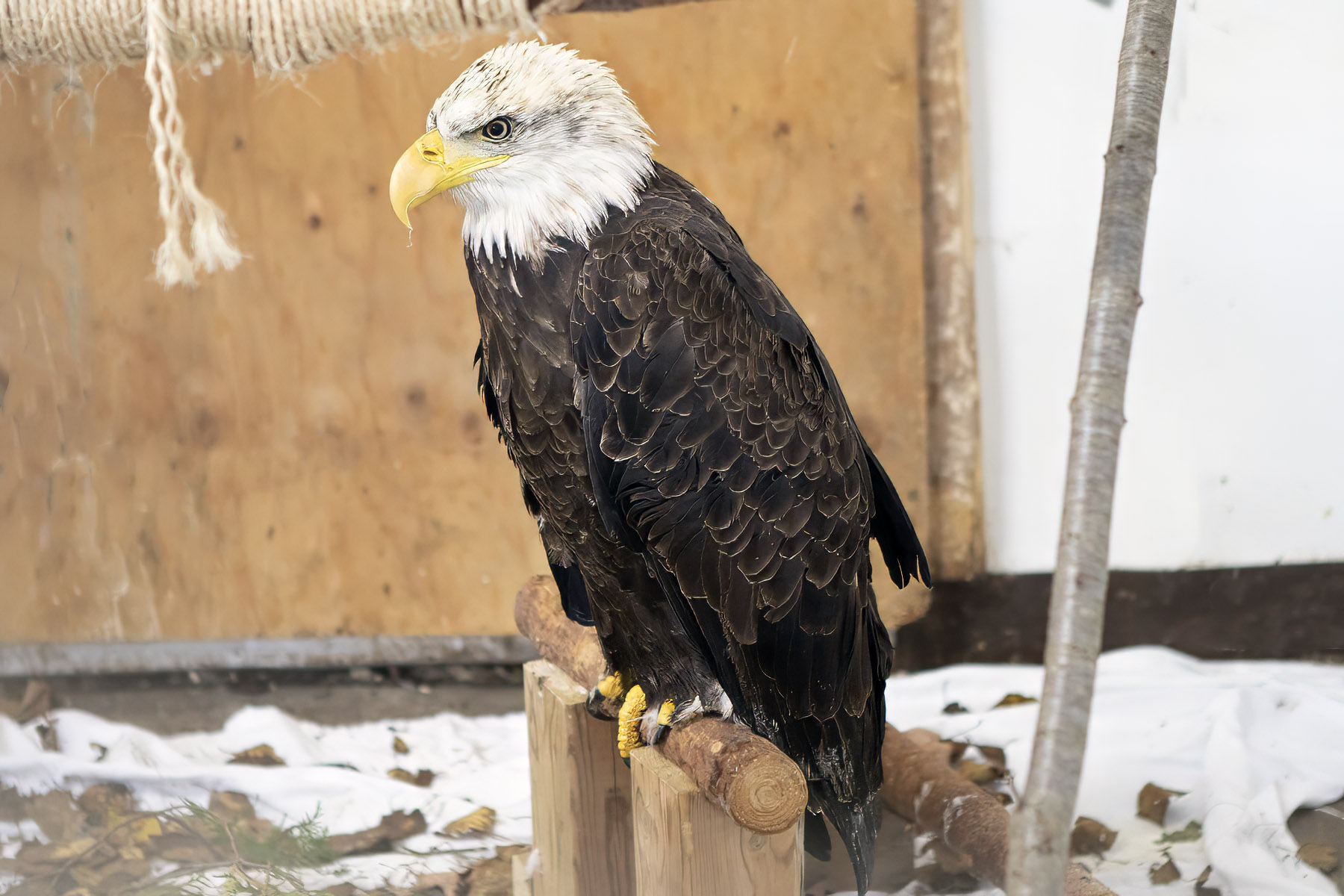
When Claire Ridgway-Herrera and her partner Adam Franks decided to go for a walk on Adam’s family land in Wahta Mohawk Territory, the last thing they expected to see was a bald eagle wedged between the trees.
For Adam, this story carries extra meaning. His father, who passed away when Adam was 14, had originally envisioned building on the land where the bald eagle, now named Rocky, was found.
“Finding the eagle directly on the path toward the future cabin site felt like a powerful, unmistakable sign to carry that vision forward,” Claire said in an email. “In many Indigenous traditions, the eagle is regarded as a sacred messenger.”
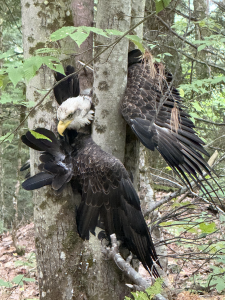
After confirming that Rocky was alive, Claire and Adam worked together to free him. Four women from Wahta arrived by boat and helped transport Rocky to Aspen Valley Wildlife Sanctuary in Rosseau.
A video of the rescue was posted to social media and has since gone viral, amounting a total of over 5.8M views and 685k likes.
At Aspen Valley, Rocky had x-rays taken to assess his wings and determine the extent of his injuries. The x-ray showed that he had a dislocated wing, which much to Rocky’s apparent displeasure was bandaged up.
After some time at Aspen Valley, Rocky was transferred to Shades of Hope Wildlife Refuge on Sept. 11, 2026, a facility that specializes in rehabilitating Ontario’s raptors.
Rocky’s medical assessment at Shades of Hope showed that he had ligament and soft tissue damage to both of his shoulders. He was also suffering from lead poisoning, which those as Shades of Hope believe caused him to end up in the tree.
“The lead poisoning throws off his cognitive abilities and muscles. He was probably chasing some prey and thought he was skirting the tree when in reality he was heading straight for it,” said Allison Taylor from Shades of Hope.
Taylor said that lead poisoning is something that is seen in quite a few of the raptors brought into their facility. She said that Rocky’s poisoning likely came from eating fish that had been within contaminated water.
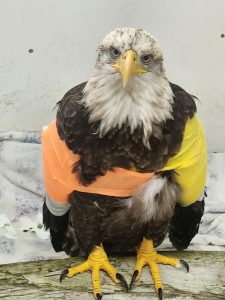
In order to bring his lead levels down, Rocky was treated with chelation therapy, a process that uses drugs and vitamins to help leach the lead out of his system. Three weeks after coming to Shades of Hope, however, staff notices pressure sores along Rocky’s keel and shoulders.
Taylor said that Rocky required surgery to remove the sores as they were attached to his keel bone.
“They would’ve come up through his skin and created open sores,” Taylor said. “We can happily say he came through the surgery with flying colours.”
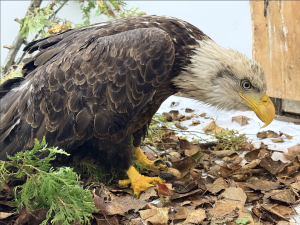
Due to his physical injuries, lead toxicity and the time of year, Rocky will be in the care of Shades of Hope until the spring. It is likely that Rocky would have migrated had he not been injured.
Initially, Rocky’s prognosis was considered guarded as the staff were unsure if there was any permanent damage to his wings, something they wouldn’t be able to see until he was up and flying.
In an update from Taylor on November 25, Rocky is now trending in the right direction.
“He has been given the clear to head out to our Raptor Roundhouse, which will allow him to increase his stamina and learn to catch prey again.”
The 4000 square foot facility includes a circular flyway, which will allow Rocky to get continual flight in order to build his muscles back up.
“Rocky should be in peak form come the spring time, when we will hopefully be able to release him back to where he was originally found.”
Ways To Support During The Holidays
With the holiday season coming up, both Aspen Valley and Shades of Hope are looking for support from the community as they prepare to care for animals over the winter.
December 1, 2026 is Giving Tuesday, a “global generosity movement unleashing the power of people and organizations to transform their communities and the world.”
For Aspen Valley, donations will support their ability to meet the considerable demands of providing lifelong care to the animals who call the sanctuary their home.
“Chance and Aurora are two of six wolves who have called Aspen Valley Wildlife Sanctuary home since 2019, following their rescue from a roadside zoo,” the sanctuary said in a social media post. “This Giving Tuesday, we’re asking you to help us keep our promise to these six wolves and the 40 other animals who call Aspen Valley home.”
Any donations made towards the Aspen Valley campaign between now and December 1st will be matched dollar for dollar, up to $36,750.
If you would like to donate to Aspen Valley Wildlife Sanctuary this Giving Tuesday, you can do so here.
For Shades of Hope, donations will support the replacement of key medical supplies and foods that will be needed for the many different animals that will spend the winter in their care.
“The unprecedented number of animals arriving at our centre has significantly depleted our resources,” the refuge said on their website. “Funds raised through this campaign will help us restock our medical suite with essential medications and other lifesaving supplies, as well as help replenish our pantry with species-specific foods.”
If the refuge can raise $50,000 by December 1st, every donation will be matched dollar for dollar.
If you would like to donate to Shades of Hope Wildlife Refuge this Giving Tuesday, you can do so here.
In addition to Giving Tuesday, Shades of Hope is also running a Winter Survival Campaign which is aimed at helping them replace habitat enrichment items as well as buy food and cleaning supplies needed for their animals.
“Quite a few animals will be wintering with us,” Taylor said. “We expect that between 200 and 300 animals will stay with us over the winter, and that doesn’t include the new ones that will be coming in during that time.”
If you would like to donate to this campaign, you can do so here.
For anyone who is unable to make a monetary donation but would still like to help, Shades of Hope accepts donations of flat sheets and fleecy blankets that will be used for their animals.
If you see an animal that is in distress in the wild, don’t hesitate to call your local animal rehabilitation centre for help.
Remember to never feed wild animals, and don’t get close to them in their natural habitats.