

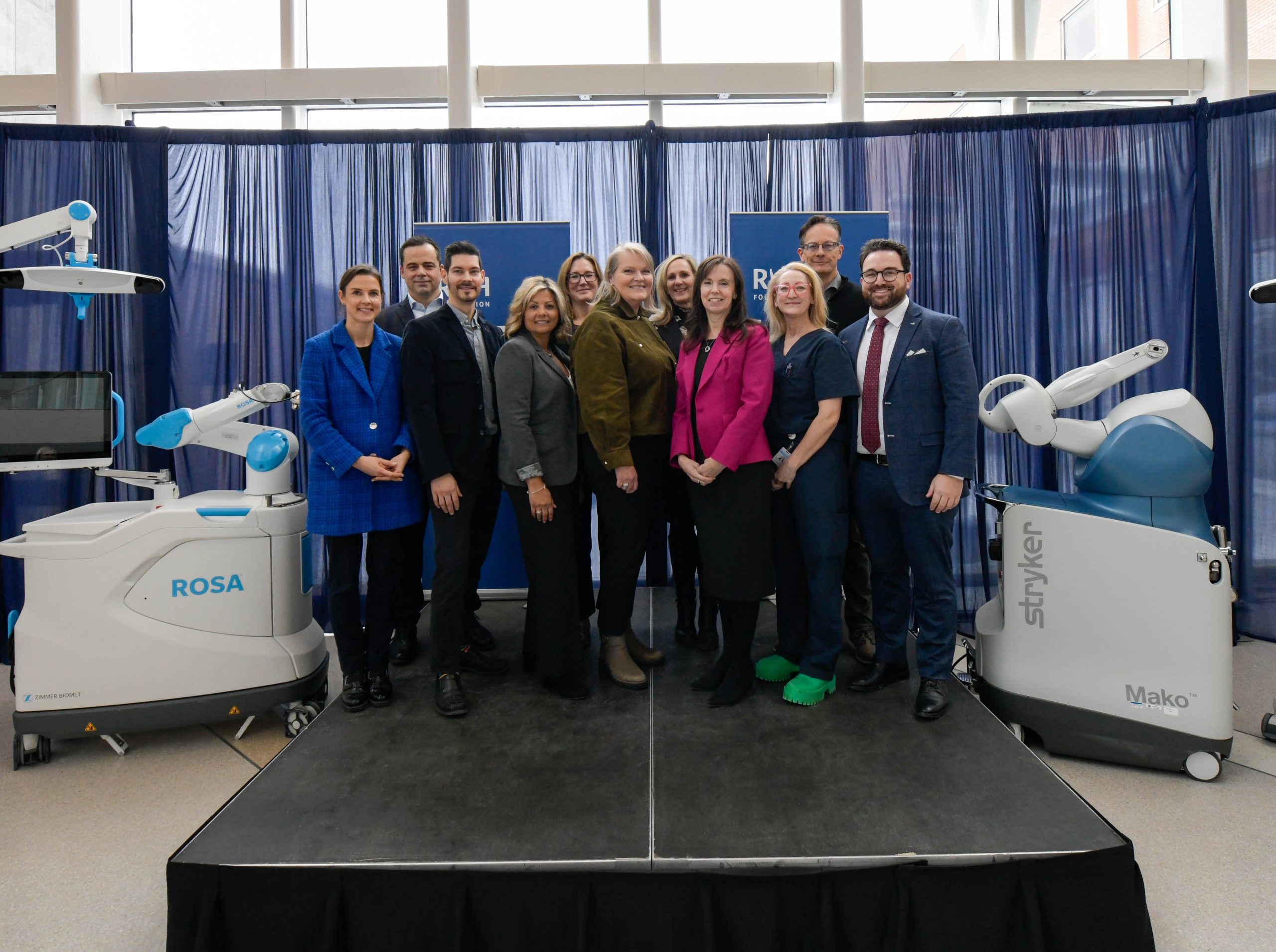
Royal Victoria Regional Health Centre (RVH) is marking a significant milestone in regional care with the launch of robotic-assisted orthopaedic surgery — an important step in advancing innovation and expanding access to advanced joint replacement procedures for patients across Simcoe MuskokaOn January 19, 2026, the first patient at RVH will receive a total knee replacement using the Zimmer Biomet ROSA® Knee System. In late February, RVH will expand the program to include the Stryker Mako SmartRobotics™ system, starting with partial knee replacements, followed by total knee and total hip replacements.
“This is a meaningful step forward in the type of technology we use and how we continue to innovate and advance care for patients across our region,” said Gail Hunt, RVH President and CEO. “As demand for orthopaedic surgery continues to grow in our rapidly expanding community, this program ensures patients can access precise, personalized, state-of-the-art care close to home, delivered by highly skilled teams and supported by an incredibly generous community.”
Robotic-assisted joint replacement combines advanced medical technology with surgical expertise to help surgeons plan each procedure around a patient’s unique anatomy using detailed imaging and real-time guidance. Surgeons remain in full control throughout the procedure, with the robotic system acting as a tool to support accuracy and consistency.
For patients, this approach can support more precise implant placement and alignment and, after surgery, may contribute to less pain, improved mobility, and a faster rehabilitation process. While every recovery is unique, robotic assistance can help optimize early recovery following surgery.
“Joint replacement surgery can be life-changing for people who have lived for years with pain and limited mobility,” said Dr. Ryan Perlus, RVH orthopaedic surgeon. “Robotic assistance allows us to tailor each procedure to the individual by using personalized surgical plans and real-time guidance to support safe, precise and consistent outcomes, while keeping the surgeon firmly in control.”
Not every patient will require or benefit from robotic-assisted surgery. In its first year, RVH expects to use robotic-assisted techniques in approximately 400 of its annual 1,400 hip and knee replacements. Traditional hip and knee replacement surgery continues to be an excellent option for many patients and is delivered every day at the health centre by highly skilled surgical teams.
Beyond patient care, robotic-assisted surgery strengthens RVH’s academic and clinical mission by supporting advanced training, research and collaboration. It also ensures RVH’s workforce is equipped with leading-edge tools and technology to deliver exceptional care today, while continuing to build capacity for the future.
Behind this advancement is the generosity of the community. Both robots are fully donor funded. Without community donations, this new surgical robotics program would not have been possible.
“There is no innovation in medicine without the backing of donors. Every major leap in care at RVH has been powered by the generosity of this community,” said Pamela Ross, CEO of RVH Foundation. “Donors built the Hudson Regional Cancer Centre. They brought advanced cardiac care home. And now, with the opening of the surgical robotics program, they’re making another leap forward in the care people here need and rightfully deserve.”
As RVH continues its transformation toward becoming a regional academic health sciences centre, robotic-assisted orthopaedic surgery represents an important step in advancing innovation, supporting care teams, and delivering high-quality, patient-centred care for the region.